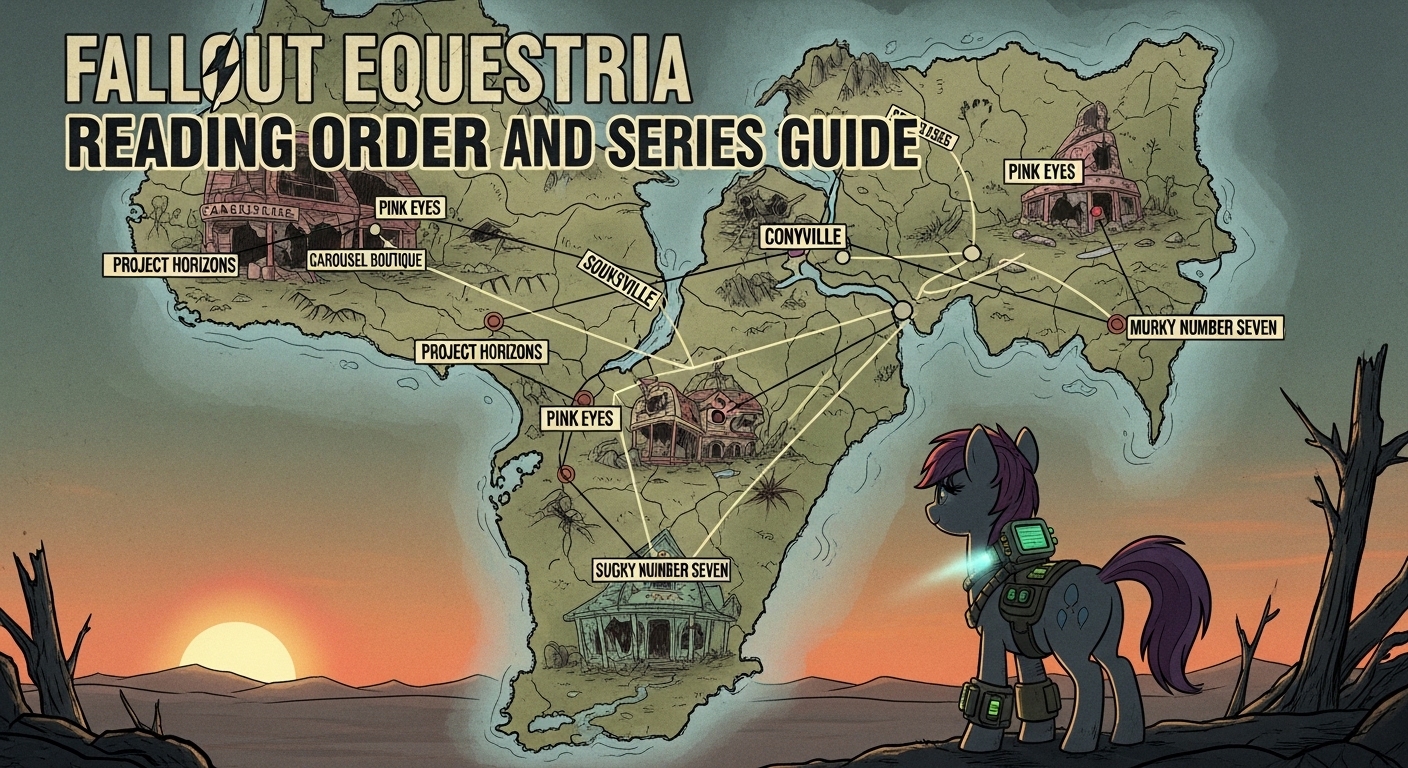
Fallout Equestria has a structured reading order that begins with the original novel and continues with officially recognized side stories created by other writers in the same universe. This guide lists the correct sequence of books, major series entries, and how each part connects within the shared timeline.
Official Starting Point: Fallout Equestria
The first and most important book in the series is Fallout Equestria by the author known as Kkat. It is the foundation of the entire expanded universe and introduces the main setting, characters, and historical background.
The story combines themes from the video game franchise Fallout with the animated television show My Little Pony: Friendship Is Magic. It also reflects elements of the broader post-apocalyptic fiction genre.
Readers should always begin with this original novel before moving to any other related books. All later stories depend on the events established in this first narrative.
The book follows a traditional structure similar to a long-form novel. It contains multiple chapters, character arcs, and detailed worldbuilding that define the rules of the fictional universe.
Fallout Equestria Project Horizons
Fallout Equestria: Project Horizons is the largest side story in the franchise. It was written by the author known as Somber and expands the universe with new characters, locations, and conflicts.
This book is often compared to a large-scale science fiction series because of its length and technical detail. It introduces advanced technology, experimental weapons, and political power struggles.
Project Horizons takes place in the same world as the original story but focuses on a different protagonist and region. The timeline overlaps with events from the main narrative.
Readers should approach this book after completing the original Fallout Equestria because it assumes knowledge of the setting and historical background.
The story explores complex topics such as social control, military discipline, and the consequences of long-term conflict related to war.
Fallout Equestria Pink Eyes
Fallout Equestria: Pink Eyes is another recognized entry in the extended universe. It was written by the author known as Mimezinga.
This book presents a shorter narrative focused on survival and exploration. The tone is simpler than Project Horizons, and the plot centers on a single character traveling through dangerous territory.
Pink Eyes belongs to the category of adventure fiction. The story emphasizes movement, discovery, and problem solving.
Readers can follow this book after finishing the original novel. It does not require the complex background knowledge needed for longer side stories.
The narrative highlights the importance of resilience and adaptability in unstable environments.
Fallout Equestria Murky Number Seven
Fallout Equestria: Murky Number Seven is a detailed side story written by the author known as Fuzzy.
The book focuses on a character living under forced labor conditions within an industrial settlement. Its themes connect to the historical concept of forced labor.
Murky Number Seven provides a close look at daily life in controlled environments. It describes production systems, supervision methods, and resistance movements.
Readers who want a deeper understanding of social conditions in the wasteland often choose this book after completing the main story.
The narrative structure resembles works of drama because it emphasizes character development and emotional pressure.
Fallout Equestria Heroes
Fallout Equestria: Heroes is another recognized addition to the series. It explores organized teams working together to rebuild communities.
The book includes discussions about leadership, cooperation, and public safety. These themes reflect real-world principles studied in public administration.
Heroes focuses on teamwork and collective responsibility. The narrative highlights how coordinated action improves survival rates.
Readers can approach this book after finishing the main novel and at least one major side story.
Recommended Basic Reading Order
The following sequence provides a simple and reliable path for new readers.
- Fallout Equestria
- Fallout Equestria: Project Horizons
- Fallout Equestria: Pink Eyes
- Fallout Equestria: Murky Number Seven
- Fallout Equestria: Heroes
This order follows the historical development of the franchise and reflects the way most readers discover the series.
The structure also supports clear understanding of the fictional timeline.
Chronological Reading Order by Timeline
Some readers prefer to follow events in chronological order rather than publication order. The following sequence reflects the internal timeline of the universe.
- Fallout Equestria: Project Horizons (early timeline segments)
- Fallout Equestria
- Fallout Equestria: Murky Number Seven
- Fallout Equestria: Pink Eyes
- Fallout Equestria: Heroes
This arrangement aligns events according to their position within the fictional history.
Chronological reading helps readers understand cause-and-effect relationships between major events.
Standalone Stories in the Fallout Equestria Universe
Several books exist as independent stories that connect loosely to the main narrative.
These works belong to the broader tradition of shared universe storytelling. Multiple authors contribute stories that take place in the same fictional setting.
Standalone entries often explore specific regions, professions, or social systems within the wasteland.
Readers can choose these stories based on personal interest without following a strict sequence.
Length and Reading Time
Fallout Equestria and its related books are known for their large size.
The original novel contains more than half a million words. This length exceeds many classic works of literature, including titles studied in English literature.
Reading time depends on individual speed. On average, readers spend several weeks or months completing the full series.
Digital versions allow adjustable text size and bookmarking features.
Printed editions provide physical access for readers who prefer traditional formats.
Publication Format and Distribution
Most Fallout Equestria books were first published online through digital platforms.
This method reflects the growth of modern electronic publishing. Writers can distribute large works without traditional printing companies.
Volunteer editors and designers created formatted versions of the text.
Some community groups organized limited print runs using small-scale printing services.
Distribution relied heavily on online communities and file-sharing systems.
Genre Classification
The Fallout Equestria series combines several literary genres.
The primary category is fantasy literature. Magical elements such as spells and mythical creatures play a central role.
The series also fits within the dystopian fiction genre because it describes a society that collapsed after disaster.
Additional influences include survival fiction, which focuses on endurance in dangerous environments.
These genre elements shape the tone and structure of the narrative.
Major Themes Across the Series
The Fallout Equestria universe explores several consistent themes.
One major theme is recovery after disaster. Communities attempt to rebuild infrastructure, restore services, and establish order.
Another theme involves responsibility and accountability. Characters must manage resources carefully and make decisions that affect others.
These themes reflect real-world concerns related to disaster recovery.
The series also addresses cooperation between groups. Successful communities depend on teamwork and communication.
World Structure and Regions
The fictional world contains multiple regions with different environmental conditions.
Urban areas include abandoned factories, transportation hubs, and damaged residential districts. These locations reflect systems studied in urban planning.
Rural regions include farmland, small towns, and natural landscapes. These areas support food production and resource collection.
Industrial zones contain equipment used for manufacturing and energy production.
Each region presents unique risks and opportunities.
Technology and Equipment Across the Series
Technology remains essential for survival throughout the reading order.
Devices such as scanners, communication radios, and navigation systems rely on principles from information technology.
Protective armor and mechanical tools require regular maintenance.
Energy production systems provide electricity for lighting, transportation, and medical equipment.
Technical knowledge determines which communities remain stable.
Communication Networks in the Universe
Communication systems connect distant settlements and support coordination.
Radio stations broadcast news, weather alerts, and emergency warnings. These systems operate within the field of mass communication.
Written records document trade agreements and legal decisions.
Courier services deliver messages when electronic systems fail.
Reliable communication improves response time during emergencies.
Education and Skill Development
Education programs appear in many Fallout Equestria stories.
Schools teach reading, mathematics, and technical training. These subjects form the foundation of modern vocational education.
Apprenticeships allow students to learn practical skills from experienced workers.
Libraries preserve manuals, historical documents, and scientific research.
Education supports long-term community development.
Trade and Resource Exchange
Trade networks allow settlements to exchange goods and services.
Caravans transport supplies between regions. These operations depend on planning and logistics studied in supply chain management.
Markets establish prices based on availability and demand.
Negotiation skills help prevent disputes.
Trade stability supports economic growth.
Security and Risk Management
Security planning remains a constant concern across the series.
Defense teams monitor borders and respond to threats. Their work involves strategies related to risk management.
Emergency drills prepare citizens for unexpected danger.
Early warning systems detect approaching hazards.
Preparedness reduces damage during crises.
Health Services in the Reading Order
Medical services play an important role in many Fallout Equestria stories.
Doctors treat injuries, infections, and chronic illness. Their work relies on knowledge from the field of clinical medicine.
Sanitation programs reduce disease spread.
Nutrition planning improves health outcomes.
Access to medical care increases survival rates.
Environmental Conditions in Different Stories
Each book in the series explores different environmental challenges.
Some regions contain contaminated water sources. Others face extreme weather conditions.
Environmental hazards reflect issues studied in environmental health.
Protective equipment helps reduce exposure to dangerous materials.
Environmental awareness improves safety planning.
Legal and Ownership Considerations
Fallout Equestria remains a fan-created project.
Original intellectual property rights belong to the companies that created the underlying franchises. These rights are protected by intellectual property law.
Fan works typically operate under noncommercial guidelines.
Writers must respect legal boundaries when distributing derivative content.
Understanding ownership rules prevents legal conflict.
Community Contribution and Collaboration
The Fallout Equestria universe expanded through community collaboration.
Writers, editors, and artists contributed new stories and artwork.
This process reflects the collaborative nature of modern online community development.
Shared creativity allowed the universe to grow beyond the original novel.
Community participation continues to support the series.
Long-Term Popularity of the Series
Fallout Equestria remains widely discussed years after its initial release.
Its structured reading order, detailed worldbuilding, and consistent themes contribute to long-term relevance.
Digital archives preserve the text for future readers.
Community interest supports ongoing creative projects.
The series continues to serve as a reference point within large-scale fanfiction literature.
