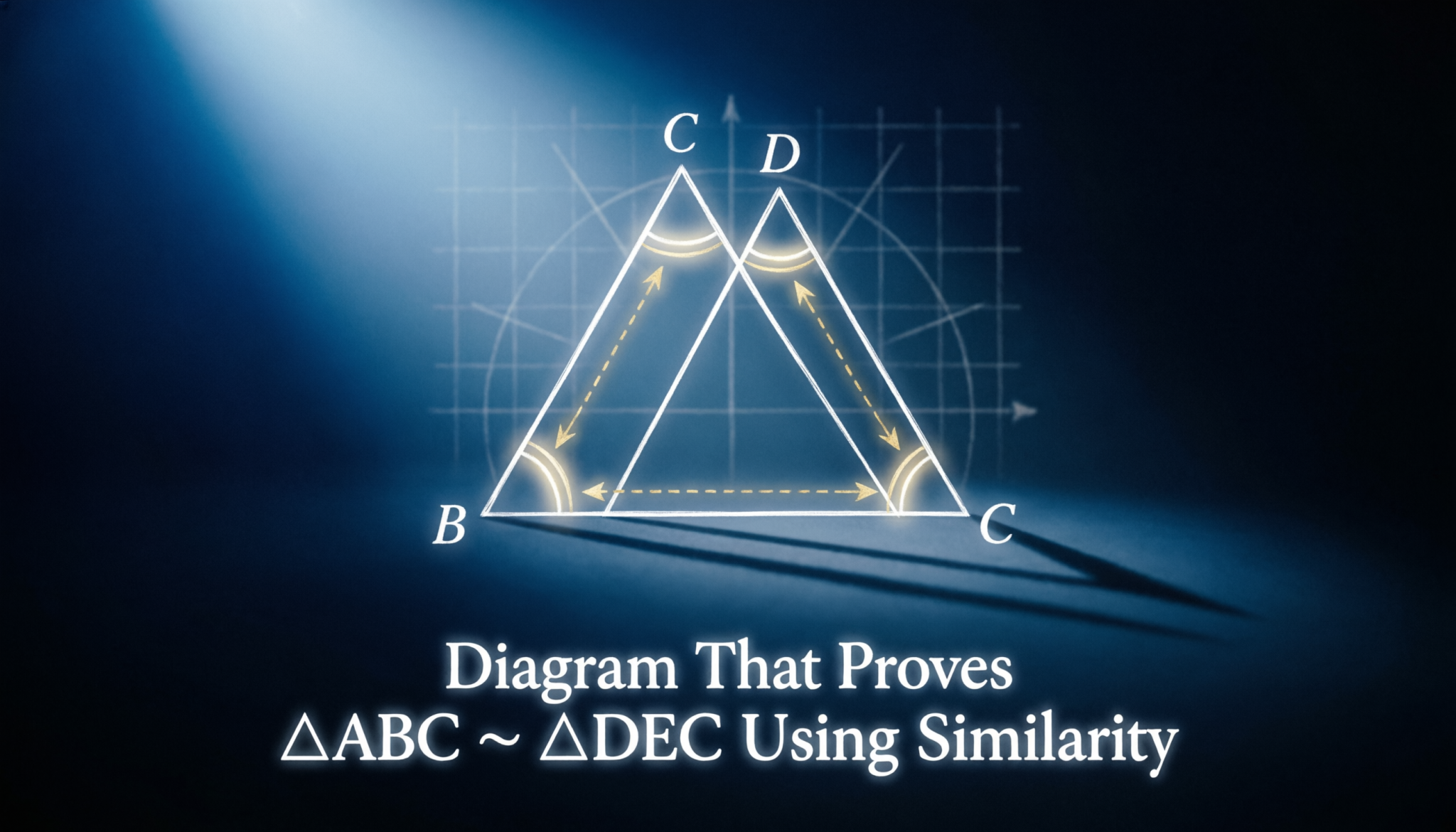
The diagram that proves △ABC ~ △DEC uses similarity transformations by showing that one triangle can be rotated, reflected, or dilated to match the other.
What Is △ABC ~ △DEC Using Similarity Transformations?
In geometry, triangles are considered similar when all their corresponding angles are equal and the lengths of their corresponding sides are proportional. This relationship between triangles is called similarity. △ABC and △DEC are examples of two triangles where similarity can be established through geometric transformations. Similarity transformations include rotation, reflection, and dilation. Each of these transformations preserves the triangle’s shape while potentially changing its size or orientation. Understanding how these transformations work is essential for visualizing and proving the similarity of triangles.
How Similarity Transformations Work
Rotation
Rotation is a transformation in which a figure is turned around a fixed point, known as the center of rotation. When a triangle is rotated, its shape and size remain unchanged. Only its orientation changes. In the context of △ABC and △DEC, rotating △ABC around a specific vertex can align it with △DEC. This alignment ensures that all corresponding angles remain equal, which is one of the key requirements for proving similarity. Rotation can be clockwise or counterclockwise, and the degree of rotation is determined based on how the triangles are positioned relative to each other.
Reflection
Reflection is another transformation that can prove triangle similarity. In reflection, a figure is flipped across a line, often called the line of reflection. The triangle’s shape remains the same, but its orientation changes. Reflecting △ABC over a line such as AC can reposition the triangle so that it matches the orientation of △DEC. Reflection is particularly useful when the triangles are mirror images of each other, as it preserves the angles while reversing the order of vertices. By using reflection followed by dilation, one can easily demonstrate the similarity between two triangles.
Dilation
Dilation is a transformation that changes the size of a figure while preserving its shape. The scale factor determines whether the triangle becomes larger or smaller. In proving △ABC ~ △DEC, dilation is applied after rotation or reflection to adjust the triangle’s size. This ensures that all corresponding sides are proportional. Dilation does not affect angles, so all corresponding angles remain equal. When combined with rotation or reflection, dilation allows △ABC to match △DEC perfectly in both shape and size, confirming the similarity of the triangles.
Steps to Prove △ABC ~ △DEC
Proving that △ABC is similar to △DEC involves several clear steps. First, the corresponding vertices of the triangles must be identified. Knowing which vertex of △ABC corresponds to which vertex of △DEC is essential for planning the transformation. Next, the required transformation must be determined. Depending on the orientation of the triangles, either rotation or reflection may be necessary. After adjusting the orientation, dilation is applied to scale △ABC so that it matches the size of △DEC. Finally, all corresponding angles are verified to be equal, and the lengths of all sides are checked for proportionality. Following this systematic approach ensures that the proof is accurate, easy to understand, and visually demonstrable in the diagram.
Choosing the Correct Diagram
Selecting the correct diagram is critical for effectively demonstrating similarity. A suitable diagram should clearly display both triangles on the same plane. It should indicate the axis of rotation or reflection when these transformations are applied. The diagram must also include labels for all vertices and key angles, making it easy to follow the steps. Including the scale factor for dilation is essential because it shows how one triangle is resized to match the other. Diagrams that combine rotation or reflection followed by dilation provide the clearest visual representation of triangle similarity. Such diagrams are particularly useful for students learning geometric transformations, as they allow the process to be seen step by step.
Importance of This Diagram in Geometry
Using diagrams to prove triangle similarity offers several advantages. Visual representations make abstract concepts more tangible and easier to understand. By showing the effects of rotation, reflection, and dilation, diagrams help students understand how triangles can change orientation and size while maintaining similarity. This visual proof is often more effective than using formulas alone because it demonstrates the relationship between angles and side lengths. It also enhances problem-solving skills, allowing learners to apply the principles of similarity in other mathematical contexts. Diagrams that demonstrate similarity transformations are essential tools in both teaching and learning geometry.
Practical Applications of Triangle Similarity
Understanding triangle similarity has real-world applications in multiple fields. In architecture and engineering, ensuring that structures are proportional is essential for stability and aesthetic appeal. In art and design, scaling shapes accurately while maintaining angles is crucial for creating consistent patterns and illustrations. In mapping, surveying, and navigation, similarity principles are applied to convert measurements while keeping angles consistent. Diagrams that visually demonstrate similarity transformations serve as practical guides for these applications, making abstract geometric concepts directly applicable to real-life problems.
Tips for Students
When working with △ABC ~ △DEC, it is important to label all triangles clearly. Marking corresponding angles before performing transformations helps prevent errors. After applying dilation, check that all sides are proportional to ensure the triangles are similar. Using grid paper or graphing tools can make rotation, reflection, and dilation more precise. Practicing with multiple examples of triangles and transformations helps students gain confidence and improve their understanding of similarity. Following these tips allows students to approach geometric proofs systematically and accurately, making the learning process more effective and intuitive.
Advanced Understanding of Triangle Similarity
For students who want to go beyond the basics, understanding the relationships between corresponding sides and angles is essential. When △ABC is transformed to match △DEC, each side of △ABC is multiplied by the scale factor of the dilation. This factor is calculated by dividing a side of △DEC by the corresponding side of △ABC. Understanding this ratio and its effect on all sides of the triangle helps in solving more complex geometric problems. Additionally, recognizing how rotation or reflection preserves angles but changes orientation is fundamental to advanced geometry concepts. Mastering these principles allows students to approach not only similarity proofs but also congruence, trigonometry, and coordinate geometry with confidence.
